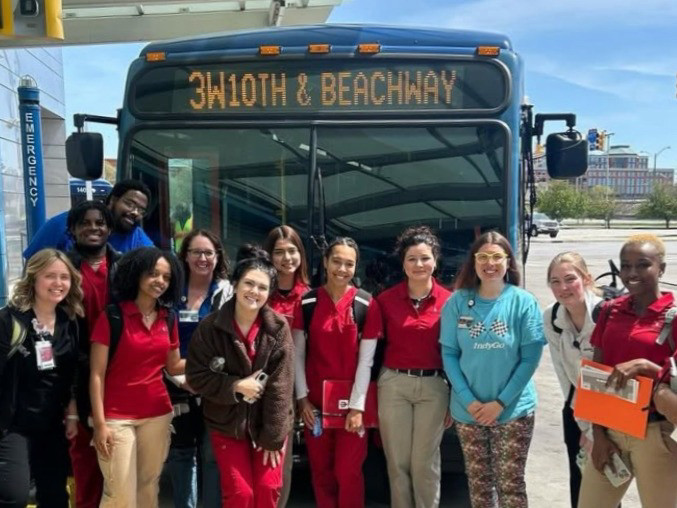
What can a city bus teach future nurses about patient care?
For students in Indiana University School of Nursing’s Healthy Populations course, the answer is clear. By stepping aboard Indianapolis’ IndyGo bus, they experience the daily reality of many of their future patients and gain insight into how transportation and access shape health outcomes.
Grace Dible, DNP, clinical assistant professor, wanted a powerful way to teach her second-year nursing students about the social determinants of health—the nonmedical factors that influence health outcomes, including where people are born, grow, work, and live. Rather than only discussing these concepts in a classroom, she challenged students to experience them. She proposed that by navigating the city using public transportation, students could better understand the barriers and resources that affect patients’ ability to access care.
Her innovative “Bus to Bedside” teaching strategy was featured in the January issue of Nurse Educator.
The first step was to debunk a common myth of riding the local bus, Dible said.
“I ride the bus regularly and have lived in other cities where public transit is how everybody gets around,” she said. “But in a city like Indianapolis that is very car dependent, I find that a lot of people are afraid to take the bus, and their first question is always, ‘Is it safe?’”
Dible discovered that IndyGo partners with the Marion County Public Health Department and other nonprofit organizations to provide community health engagement programs. These include a mobile medical clinic and a Transit Ambassador program that recruits volunteers to teach residents how to confidently navigate the transit system.
“It turns out that IndyGo already had transit training in place, so we just modified what they offer to match up with the objectives for the Healthy Populations course,” she said.
She launched the IndyGo training component last year, and so far, 40 students have completed the experience. Another cohort of 20 will participate in April.
During the three-hour training, students work alongside the transit ambassadors and community outreach team members to learn how to use digital mapping tools, such as Google Maps, to plan routes and travel to destinations across the city. They also learn about key transit-community health partnerships, including connections to the health department and local hospital systems.
“We learned which routes go by major healthcare systems and how we would talk to our patients if they’ve never taken the bus before,” Dible said.
The training also challenges assumptions.
“We learned that a study done by IndyGo found their average rider is a middle-aged Black woman commuting to work and rides the bus at least five days a week,” Dible said. “It really debunked what people think about who uses the bus to get around.”
Student Lisa Lopez, who participated in Dible’s recent training cohort, said the experience wasn’t what she first expected, but quickly proved meaningful.
“At first, I didn’t understand why we would be riding the IndyGo as part of our clinical experience,” she said. “As the day went on it became apparent that this was a resource that is vital in our community and knowing our way around it can help us as future nurses be a resource for those in need.
“There were so many lives and stories on the IndyGo,” Lopez continued. “Plenty of people let us sit by them and talk about public health topics we’ve studied in class and were kindly listening. This experience showed that there’s so much more community and support around us than we realized.”