

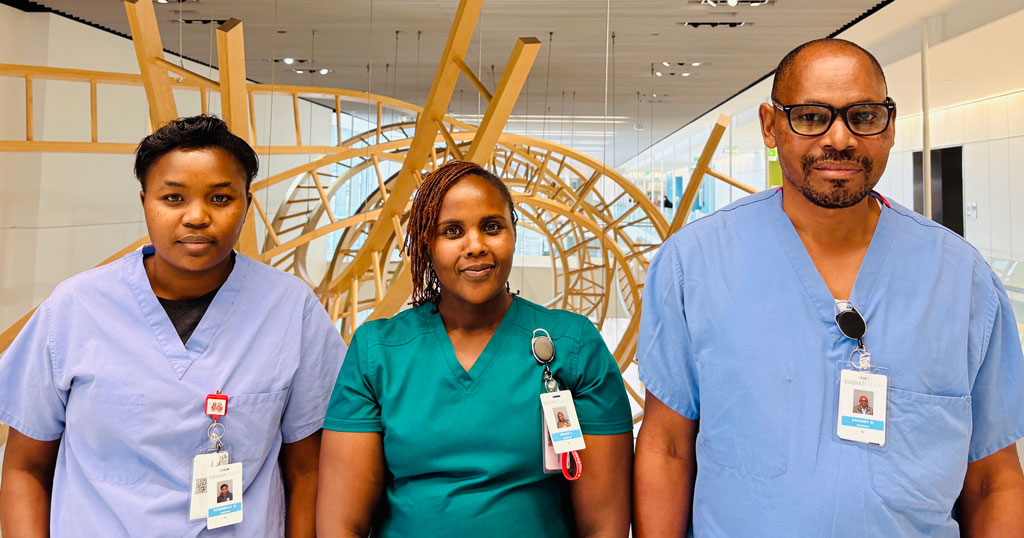
With a new burn center taking shape in Kenya, three nurses from Moi Teaching and Referral Hospital’s burn unit in Eldoret have spent four weeks at the Indiana University School of Nursing in Indianapolis to learn practices they can adapt to their own setting once they return.
The nurses’ visit with the School of Nursing, which began on October 12 and concludes this week, has included training rotations in the emergency department and burn center at Eskenazi Health, the wound care department at IU Methodist Hospital, and Riley Children’s Health’s Burn Program.
The visit is part of the Academic Model Providing Access to Healthcare (AMPATH) Kenya partnership that connects Moi University, Moi Teaching and Referral Hospital (MTRH), and a consortium of universities led by IU. The nurses’ visit was supported by a grant from the Health Carousel Foundation obtained through the IU Center for Global Health.
School of Nursing faculty liaison, Lindsay Haskett, PhD, RN, was part of large team that included IU Health professionals who helped coordinate the nurses’ clinical experiences at the three hospitals and connected them with resources relevant to the development of the new burn center in Kenya.
“These nurses bring a wealth of clinical experience and an understanding of the patients, resources, and healthcare environment in Kenya,” she said. “During these rotations, they have had the opportunity to observe different approaches to burn care, discuss practices with their U.S. colleagues, and identify strategies that can be adapted to their own setting.”
Learning across care settings
For Petronilla Gesare Okemwa, who has worked at MTRH for 10 years, the visit indeed allowed her to explore how she could improve care for the burn patients she cares for during a typical day in MTRH’s burn unit.
“MTRH is a very busy institution with approximately a 1 to 30 nurse-to-patient ratio on most days,” she explained. “We usually report early morning and do most of the procedures then. We have some students to mentor during the shift. Some of the activities that we do are wound care, drug administration, and patient education that entails teaching the patients on their diagnosis, their care, and the discharge instructions.”
One difference that stood out to the visiting nurses was how closely patients are included in their care.
“One of the most striking things that I learned here is the patient education and how nurses involve the patients in what happens during a pre-procedure, in the procedure room, and even after discharge,” said Hellen Jemeli, who has worked at MTRH for 19 years and cares for patients in the pediatric burn unit. “The nurses really talk to their patients in a respectful manner and explain how they will be cared for.”
Jemeli added she also learned that careful observation can help nurses monitor patients who are sedated, even without many machines. She pointed to infection prevention and patient identification as other practices she hopes to take home.
Zachary Oroo, who has 21 years of experience, came to learn why patients with burns often stay at MTRH for a long time and how the hospital might reduce deaths related to complications.
“When we were given this opportunity to come to the United States, of course we expected to find something different from what we are doing back at home,” he said. “One thing that I will be able to take home is the idea of early referrals of patients. Because the challenge that we have back at home is the late referral of burns patients who come with already complicated wounds, which are septic.”
Oroo also described being impressed by the coordination he saw in the emergency department, including paramedics handing off patients to a waiting multidisciplinary team.
A network that extends beyond the visit
The nurses’ observations will feed into an ongoing exchange among nursing colleagues across partner institutions, Haskett said. The School of Nursing and AMPATH partners will continue supporting the nurses after they return to Kenya.
“Through AMPATH, we have an established nursing workgroup that meets monthly and brings together nursing colleagues from partner institutions in North America, Kenya, Ghana, Nepal, and Mexico,” Haskett explained. “That provides an ongoing forum to share experiences, discuss challenges, and continue learning from one another as the Moi University and MTRH teams determine how different practices can be adapted to their resources and patient population.”
“Three additional nurses are expected to participate in early 2027,” she continued. “That gives us an opportunity to build on what this first group has learned rather than treating each visit as a separate experience.”
The exchange is part of a broader effort to expand burn care in Kenya, including the Harry Dyer Burn Center. Named for a fourth-generation Kenyan bush pilot, the center honors Dyer, who was badly burned when his plane crashed while he was patrolling Tsavo National Park for poachers in 2017.
With burns covering more than 45 percent of his body, Dyer had limited access to specialized burn care in Africa. His friend Trey Fehsenfeld and family helped arrange treatment at Eskenazi Health in Indianapolis, where Dyer later received physical therapy and laser treatment for his scars.
Made possible by philanthropic partnerships, the center is expected to be Kenya’s first dedicated burn treatment facility and will serve patients from across the region.