

For doctoral nursing students, the path from an idea that could improve healthcare to research that can make a difference requires more than determination. It also requires resources. For three past and present Indiana University School of Nursing PhD students, support from the Swisher Foundation helped ease the financial burden of completing a doctoral degree, giving each scholar greater freedom to focus on work that can ultimately benefit their communities.
For more than four decades, the Indianapolis-based Swisher Foundation, Inc. has supported educational institutions, healthcare organizations, and research initiatives across Indiana. In 2022, the foundation established the Swisher Foundation PhD Student Research Fellowship—the first fellowship at the IU School of Nursing dedicated specifically to supporting PhD students as they complete their degrees.
The fellowship reflects the Swisher Foundation’s and IU School of Nursing’s shared commitment to advancing nursing science and preparing the next generation of nurse scientists. By providing philanthropic support at a critical point in students’ academic journeys, the fellowship helps emerging scholars launch research careers and pursue discoveries that can improve patient care in Indiana and beyond.
Brothers Glenn M. Swisher, Jr., and Charles Swisher serve as directors of the foundation, continuing the philanthropic legacy established by their father, Glenn M. Swisher. In 2026, the foundation was inducted into the IU President’s Circle, which recognizes IU’s most generous donors.
For Swisher Fellowship recipients, the support has helped turn philanthropic dollars into practical resources.
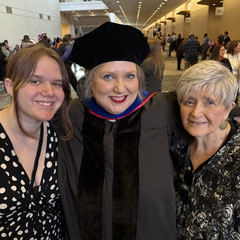
Erin Wyatt, PhD, RN, clinical assistant professor at the IU School of Nursing in Bloomington, is the course coordinator for “Fundamentals of Nursing” and teaches two practicum courses, having a direct impact on the next generation of nursing professionals. She is a recent May graduate from the PhD program and defended her dissertation in July.
Wyatt’s interest in pursuing a PhD grew from her early experiences caring for and educating people diagnosed with cancer, where she saw how research could directly influence the health of patients and communities.
“Early in my career, I worked as a patient educator/navigator for people who had been diagnosed with cancer,” she said. “I became an Oncology Certified Nurse and Certified Breast Care Nurse, so I spent a lot of time reading journal articles to maintain my certification through continuing education, and I decided that one day I wanted to be able to conduct research that could improve the health of my patients and community, so I pursued my PhD.”
Wyatt’s dissertation, “Transgender Women’s Experiences with Seeking Preventive Care,” explored an important dimension of access to healthcare. Support from the Swisher Fellowship helped her meet some of the costs associated with conducting the research.
“The funds from the Swisher Fellowship helped me pay for things that were necessary to complete my research like transcription services for my qualitative interviews and gift cards to compensate the individuals who participated in my study,” she explained. “I am so grateful for the assistance because it would have been extremely challenging to cover those costs without the extra financial help.”

Aaron McCord, PhD, FNP, graduated with a PhD in Nursing Science in 2024 and was finalizing his dissertation when he was awarded the fellowship. His dissertation, “Career Decision-Making in Diverse Nursing Students: Choosing a Career in Nursing,” examined student diversity among three levels of nursing programs—licensed practical nurse, associate degree, and Bachelor of Science programs. His research explored why participants chose nursing careers as well as the barriers and facilitators they encountered in pursuing their goals.
As McCord approached the final stages of his doctorate, the fellowship helped cover expenses associated with completing his dissertation.
“Because I received a fellowship from the Swisher Foundation, I was able to ensure that my dissertation was completed as professionally as possible,” McCord recalled. “The scholarship allowed me to use a better online email platform for my research and to hire someone to help with editing. The support of the Swisher Foundation took some of the pressure off the process, and any help with lowering the stress of a dissertation process is incredibly valuable,” he added.

Nikki Benich is currently collecting data for her dissertation as a PhD in Nursing Science student. The Swisher Foundation fellowship is providing much-needed support for her research on the sustainability of nurse-led changes in acute care settings.
“As a clinical nursing director in the acute care hospital setting, I have spent my leadership career working to implement and sustain changes, or examining why certain initiatives fail to stick,” she said. “My research on the sustainability of nurse-led changes aims to serve as a foundational body of empirical knowledge specific to the nursing profession, aiding future sustainability research and improving clinical care delivery.”
For Benich, the fellowship made it possible to bring additional expertise to the research process.
“As a healthcare executive, this fellowship has allowed me to strategically extend my resources by hiring a research assistant to assist with qualitative coding,” she explained. “This enabled me to rigorously analyze data from the rich pool of participant information provided in my study.”
After graduation, Benich plans to catch up on personal objectives set aside during her studies while continuing to apply her academic knowledge to help her colleagues understand how to successfully approach and sustain the changes they lead.
Although Wyatt, McCord, and Benich have pursued different research questions, their experiences share a common thread: timely philanthropic support gave each of them resources to move important work forward. Their stories demonstrate the lasting reach of an investment such as the Swisher Foundation PhD Student Research Fellowship. When donors support nurse scientists, they also help support the patients, students, and communities that the work of those scientists ultimately reaches.