IU's Interprofessional Simulation Center Prepares Tomorrow's Healers
By John Simmons
Wednesday, August 05, 2026
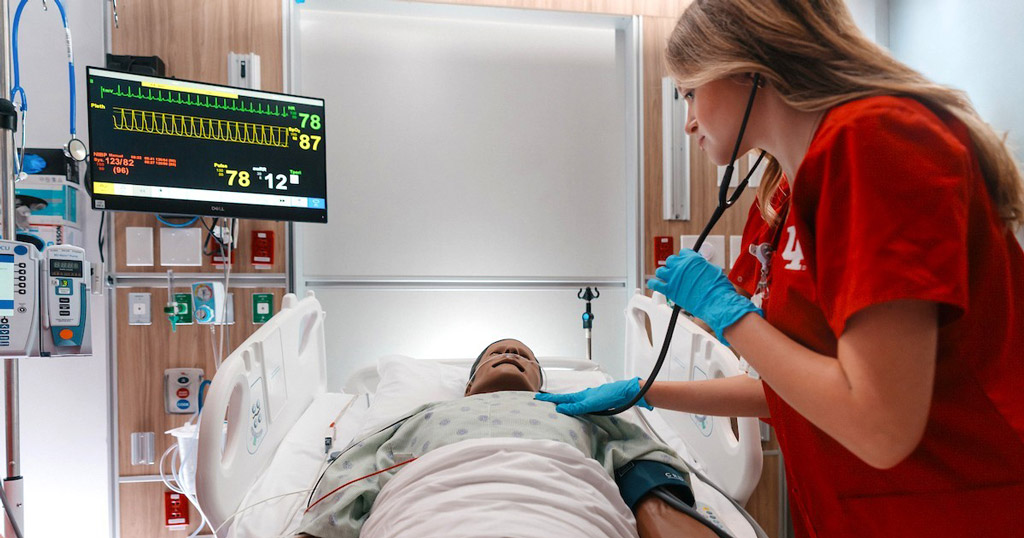
The SIM Center's high-fidelity manikins recreate a wide range of patient symptoms.
In healthcare education, some of the most important lessons happen long before a student enters a hospital room.
Before they ever touch a real patient, Indiana University School of Nursing students in Bloomington can deliver babies, respond to cardiac arrests, evaluate complex cases, and work alongside future physicians and other healthcare professionals in a safe environment where mistakes become learning opportunities rather than risks to patients.
These experiences are made possible through IU's Interprofessional Simulation (SIM) Center. Opened in 2021 through a partnership between IU Health and the IU Schools of Nursing and Medicine, the 12,000-square-foot facility has become a cornerstone of hands-on healthcare education on the Bloomington campus.
A Simple Idea
At its core, Bloomington's SIM Center is founded on a simple idea: healthcare education works best when students learn together. Bringing IU's Schools of Nursing, Medicine, and Social Work, along with the Department of Speech, Language and Hearing Sciences, into the Health Sciences Building (home of the SIM) created opportunities for collaboration that weren't possible when programs were spread across campus.
“The Interprofessional Simulation Center was well-positioned to give nursing, medical, social work, and SLHS students the opportunity to learn together in realistic clinical settings,” said David Rodgers, the SIM's director and an associate professor of clinical medicine. “By bringing these programs together in one building, we were able to share resources and create a stronger interprofessional learning experience.”
Where Learning Feels Real
The SIM Center greatly expanded IU's simulation capabilities with its seven simulation rooms, seven control rooms, seven post-simulation debriefing rooms, and a community assessment apartment where students can practice caring for patients in realistic home settings.
At the heart of the center are its high-fidelity manikins—life-size computer-controlled models that blink, breathe, bleed, cry, sweat, and display realistic heartbeats and pulses. Specialized obstetric, neonatal, and pediatric manikins help learners build skills in labor and delivery, newborn care, and pediatrics. Students also work with standardized patients who are trained actors who portray a variety of conditions and scenarios to help the students develop communication, assessment, and clinical skills.
The center’s staff, including simulation manager and former Army medic Shad Wiehe and its technical support team, are also on hand to work with faculty and educators to build learning experiences that meet their goals.
“Whether it’s a student’s first or last time in the SIM Center, we always review the manikin and equipment so they can focus on patient care,” said Wiehe. “We’re also very fortunate to have all our full-time staff come from the healthcare field. Their healthcare experience helps bring the simulations to life, often making students forget they're interacting with a manikin and not a real patient.”
Just as impressive as this initial technology is the SIM Center's commitment to continually expanding its capabilities. Strategic acquisitions reflect IU’s dedication to providing learners with some of the most advanced simulation technology:
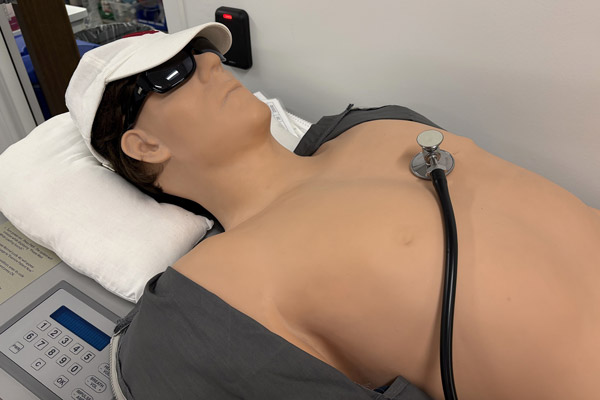
Harvey®, the SIM Center’s sophisticated cardiopulmonary patient simulator, has some downtime between simulations.
Harvey®—a cardiopulmonary patient simulator that recreates more than 50 heart and lung conditions in children and adults, allowing students to recognize changes in blood pressure, pulses, heart sounds, murmurs, and breath sounds.
SimMan®—replicates complex clinical scenarios, giving learners hands-on experience in emergency, trauma, respiratory, point-of-care, and critical care settings. Bloomington's SIM Center was among the first programs in the nation to obtain the latest version of SimMan® Critical Care.
PeriOp Sim—places students in a virtual operating room, guiding and evaluating them as they perform dozens of common surgical procedures and exposing them to clinical scenarios they may not have encountered during their clinical rotations.
Vimedix Ultrasound Simulator—allows learners to practice ultrasound imaging and interpretation using a high-fidelity manikin and realistic imaging software.
As the SIM Center's technology and programming continue to evolve, so does its impact. In 2025, it hosted 845 simulation sessions for 9,137 learners across the Schools of Nursing, Medicine and other IU programs, totaling 26,995 contact hours. Rodgers expects that impact to continue growing in 2026.
Beyond Technology
The SIM Center’s innovation extends beyond technology. Each year, the center expands its simulation offerings, exposing learners to a broader range of patient conditions, clinical situations, and interprofessional experiences.
Recent additions for the School of Nursing, for example, include a newborn twins’ simulation and a schizophrenia case integrated into Nursing's interprofessional simulation with the School of Social Work.
The center also continues to create learning opportunities through innovative partnerships. In 2025, the SIM Center collaborated with IU's student-led Intra-Collegiate Emergency Medical Services on a full-scale disaster drill during the annual IU Little 500—the nation’s largest collegiate bike race. Simulating a bleacher collapse, the exercise brought together students, healthcare providers, first responders, and emergency management teams to practice coordinated patient rescue, triage, treatment, and transport in a realistic mass-casualty scenario.
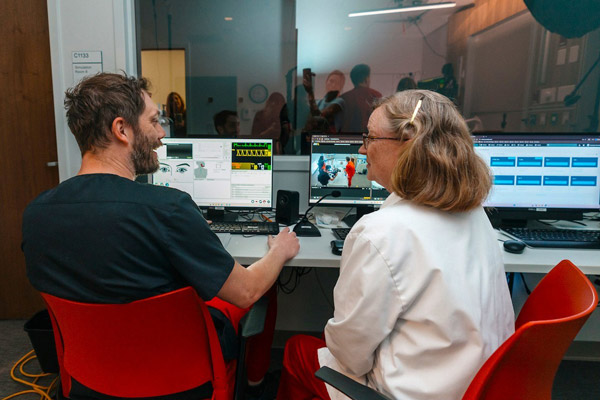
SIM Manager Shad Wiehe and Lecturer Ronda Hendricks make final preparations for an upcoming simulation.
The SIM Center has also strengthened IU's reputation as a research-intensive institution by serving as a hub for simulation-based scholarship. Since 2023, Bloomington students, faculty, and staff from the Schools of Nursing and Medicine and the Interprofessional Simulation Center have published more than 20 peer-reviewed articles, including being published in Simulation in Healthcare, the field's leading journal.
Looking Ahead
Bloomington's SIM Center is fully accredited by the Society for Simulation in Healthcare in the core areas of Assessment, Teaching/Learning, and Systems Integration and is one of just five simulation programs in Indiana to hold SSH accreditation.
In looking to the future, Rodgers said: “Experiential immersive learning is becoming a stronger focus in many health professions curriculums. The Bloomington simulation program is prepared to meet current and future needs with the right blend of technology, people, and curricula.”
IU School of Nursing - Resources and social media channels