

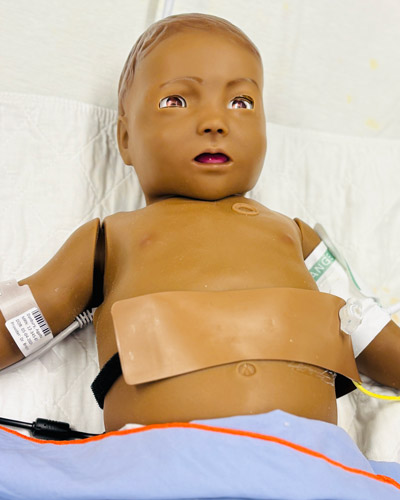
On a recent November afternoon, IU School of Nursing students took turns threading a gastric feeding tube into a tiny infant while his anxious mother watched from the bedside. Soon enough, many of these future nurses will perform similar procedures on real patients.
But on this day, the tension in the room was staged: the infant was a high-fidelity manikin, the mother a fellow student in role play, and the entire scene part of a pediatric simulation inside the Jean Johnson Schaefer Resource Center for Innovation in Clinical Nursing Education on the Indianapolis campus.
Sessions like this form the backbone of hands-on training in the “Learning Lab,” where students encounter scenarios that mimic the unpredictability of real clinical care. In Indianapolis, the School of Nursing also partners with the IU School of Medicine to train students in the Simulation Center at Fairbanks Hall—a 30,000-square-foot state-of-the-art facility. Similar Simulation and Skills Centers support learners at the Bloomington and Fort Wayne campuses, ensuring consistent practice opportunities across the state.
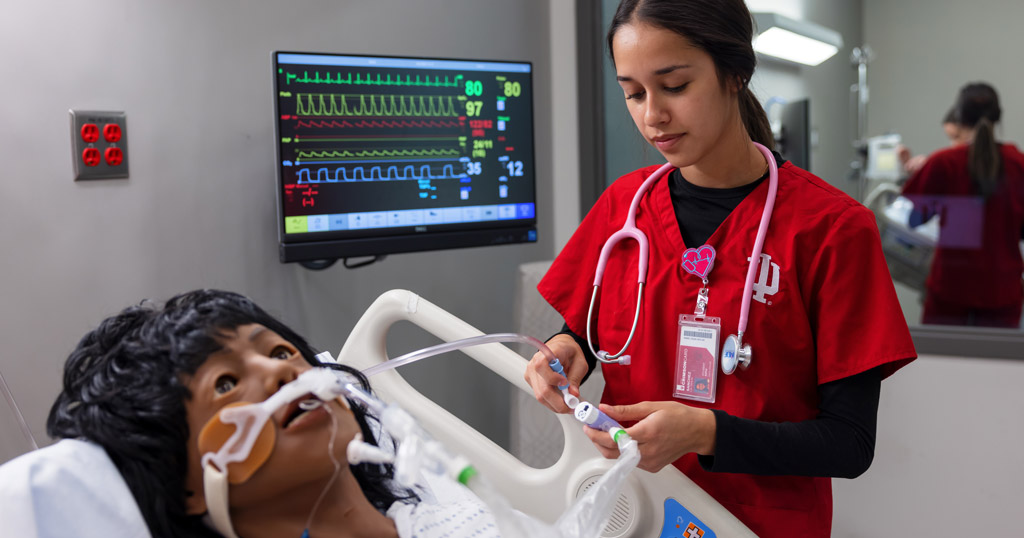
Computerized manikin “patients” are at the core of simulation education, ranging from newborns to adults. They can be assigned medical histories, and can be programmed with vital signs, pulses, pupil responses, realistic voices, and even bodily fluids. The manikins respond to the students’ “care” with, for example, blood pressure changes, groans, and convulsions.
A Long Way from Resusci Anne
Decades of research has shown the use of simulators in medical education reduces risks to patients and improves learners’ competence and confidence. The use of manikin simulators dates to the 1960s with the introduction of Resusci Anne, the first CPR training manikin. The dolls have come a long way since then.
Megan Stuffle, DNP, RN, assistant dean of Learning Resources, has watched the evolution up close.
“I did simulation as an undergraduate student, and at the time, it was a low-fidelity manikin that wasn't computerized and was essentially a doll in a bed where your faculty called out vital signs,” she recalled. “We then started being able to hook the manikin up to computers and give them heart and lung sounds. Now we're at a point where AI is being incorporated into simulation and new technology like virtual reality totally immerses our students.”
The transformation isn’t slowing down, Stuffle said. AI-driven simulations promise even more immersive training in the years ahead.
A Safe Place to Learn and Grow
IU nursing students step into the Learning Lab during their very first semester, and every clinical course has a simulation component. During its busiest weeks, more than 200 students rotate through the center’s scenarios, said Simulation Coordinator Rachell Laughlin.
From her control room behind a two-way mirror, Laughlin programs both adult and pediatric cases, changing vital signs, symptoms, and patient behaviors in real time. Each scenario is crafted to build core nursing competencies, such as:
- Clinical judgment and prioritization
- Safe medication administration
- Team communication
- Patient and family education
- Psychomotor skills and technical proficiency
“The most rewarding part is watching the students gain confidence in their practice and witnessing the associative learning,” Laughlin said. “Simulation gives them a safe, supportive space to explore, make mistakes, ask questions, and really grow into their roles as future nurses.”
For senior BSN student Timi Aderinwale, who had just completed the pediatric simulation session, that safe space is invaluable.
“I love that the Sim Center gives us the opportunities to merge what we're learning in class and practice the skills that we learn in a real sense without inflicting harm on anyone,” she said. “You're free to make mistakes, which is great because the mistakes really stick with you, and I won’t make the same one again.”
During the recent pediatric event, teams of students rotated through four scenarios, including respiratory illness, discharge education, and the “G-tube” insertion. Two students typically assume the role of nurses while a third plays a family member, guided by cues through an earpiece. Meanwhile, classmates observe via livestream, taking notes for a group debrief.
“At the end, they come back together to talk about what went well and what they want to improve,” Stuffle explained. “That reflection is one of the most powerful parts of the experience.”
Cole Moritz, a senior who aims to work in a Cardiovascular ICU after his May graduation, had just completed a group debriefing and said he enjoys the challenge the simulations provide. He credits the faculty for making them “so realistic.”
“It's a surreal feeling training with the manikins, especially being a senior, knowing that a year from now I'll be on my own and caring for real patients as an actual nurse.”